Last Week’s Goals
Create the Item Crafting UI
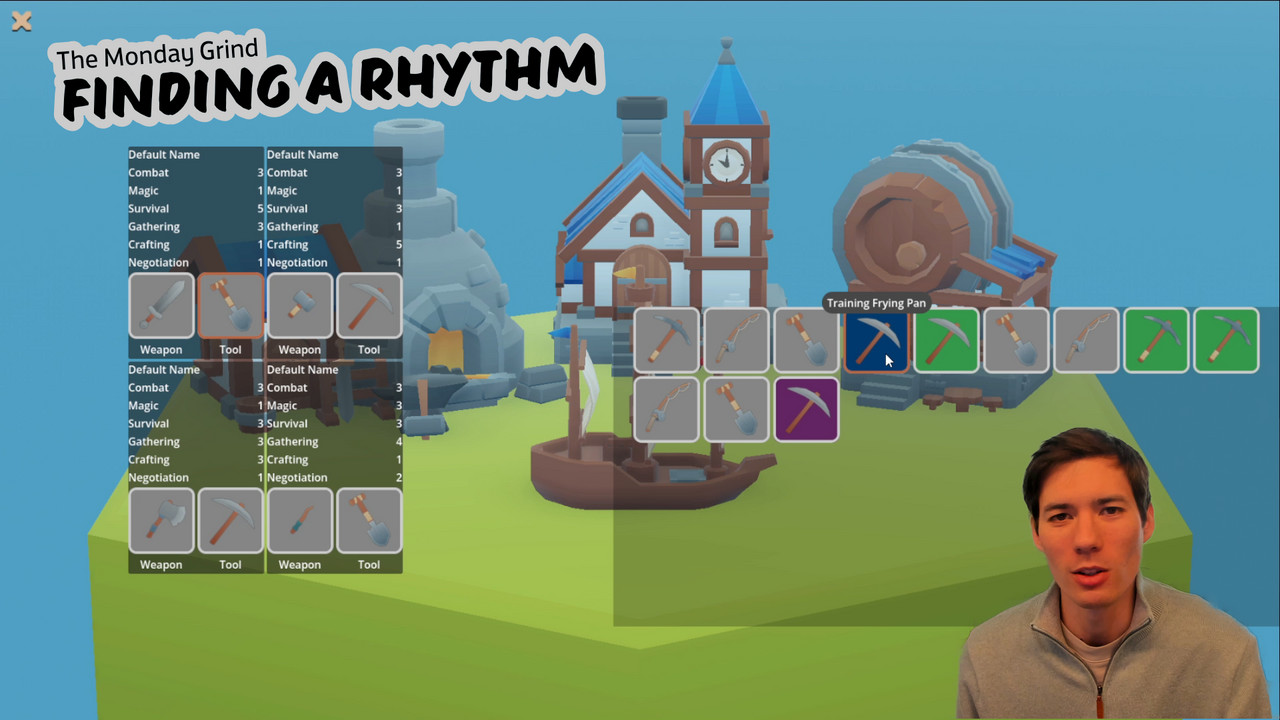
The crafting UI has been created and pulls in the data that I need. It also has the crafting function built in to place items in the player’s inventory. Once that was all set in place, I wanted to actually start working toward equipping items. I built the UI with the idea of “equipment cards” in mind, so I was able to reuse some of the widgets for my inventory display. Check out the video version of the podcast to see how far I was able to progress on that this week.
This Week’s Goals
Party Member Equipment Management
Even though I have the initial parts of the equipment management in place, there are still a lot of considerations I need to make. It’s amusing to me that whenever I add in some set of functionality it instantly creates more work to finish the thought. In reality, that work was always there. I just wasn’t able to comprehend that I would need additional systems until I see the work in front of me and play through the game. This is one of the reasons why I love sitting down to play my game at the start of every session. It helps me reset my focus on the important items based on what I experience being in the mind of a player.
Update Missions
If I can keep up pace with daily progress, I would like to go through and update the missions to better align with how the game currently functions. The original missions were written with the assumption that players could explore infinitely. I still like the idea of having one big final mission signal the end of the demo, but how the player builds up to that point needs some tuning. Especially after I have items fully working and ready to go.
Side Topics
“Entry Level Games”
One of the questions that we get asked as kids is “what do you want to be when you grow up?” or another way of saying “what is your dream job?”. The equivalent question in game dev would be “What is your dream game?”. As enticing as it would be to work on a large game, I know that I still have to work up my skills to get to that point. However, thinking about my own career journey and how I learned skills along the way gave me a new perspective to think about how to approach game development. Starting out, I worked jobs that didn’t require a lot of expertise to get into. The skills I learned while working those jobs paved the way for me to have the skills and confidence to move up to the next job and so on. The skills I am working on and honing in my current job are much more advanced than when I started out, and I wouldn’t have been able to get there if I hadn’t built that foundation first.
So the question becomes, “What is a good entry level game?”. At least for me, I want to pull my focus back to games where the player is spending most of their time doing simple action verbs. “Fighting”, “Collecting”, “Flapping” or any sort of those verbs are great. “Clicking”, “Managing”, “Engineering” are all the kinds of verbs that are outside of what I’m considering. An ideal entry level game for me would have the player spending 80% of play time doing simple verbs and 20% of the playtime doing complex verbs. As I become a better game creator, I will be able to adjust that ratio and even increase the number of verbs I support. Here are some of the examples that I think make for great entry level games to get inspired by:
Puzzle Milk Tea (Yep, I’m biased!)
Bloons Tower Defense (make one map and a handful of towers)
Windjammers (Pong, with a little bit more flare)
Any Kirby or Mario Party minigame (probably)
Top down arcade racer
Taking any of these ideas, remaking it, and then adding a little bit more should be doable in a reasonable time frame. The last important part is to pair it up with something that pushes the boundaries a little bit more. Just like navigating a career, some time should be spent doing the responsibilities of the next role. At some point, you’ll find that you are ready to move up to the next level and grow from there.